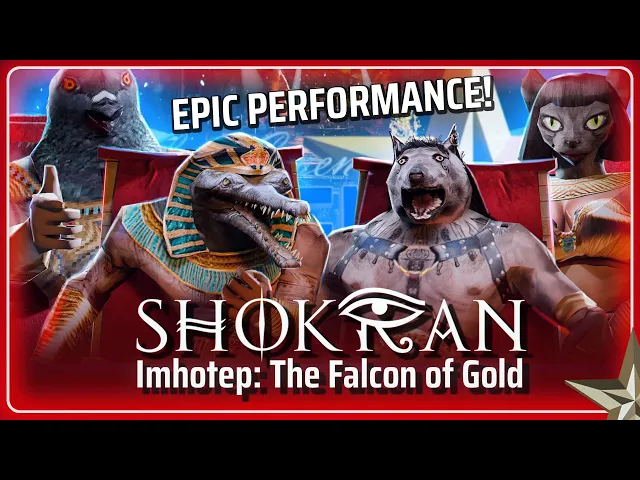
SHOKRAN

Blender Music Video

Overview

Last year, I got the opportunity to direct and produce a music video for the band Shokran. I had wanted to experiment with crowd simulation and ragdoll physics for a long time, and this project turned out to be the perfect chance to bring that idea to life.

After brainstorming, we came up with a talent show concept where performers are judged by ancient Egyptian gods, and the musicians have to win over all the judges. The ancient Egyptian theme was crucial, as the band heavily incorporates Egyptian imagery and mythology into their visual identity and sound.

You can watch the full breakdown right here or check it out in the "Other" section.

First, I started by creating the environment. As a base, I took ancient amphitheaters and redesigned them into something resembling a modern stage. It was important for me to preserve the scale and atmosphere of the amphitheater while adapting it for a modern musical production, ensuring the stage looked organic for the music video and supported the talent show concept.

Beyond the stage and amphitheater, I built the surrounding environment. I didn't overcomplicate this part - the main goal was to make the space look logical and support the atmosphere of the video without drawing attention away from the main action on stage.

Next came character creation. We tried to give each character a unique feel, both visually and through their personality and behavior. For the musicians, I used a single base model, creating variety through unique textures. Meanwhile, completely unique models were created for the gods to emphasize how distinct they are

This is where the main challenge arose. At first, I thought I could handle the ragdoll animation in Blender. I ran many tests, but none of the results satisfied me. It only looked somewhat acceptable when a model had no animation and simply dropped to the floor, and even then, it only worked properly with a single character.

However, my original idea required a crowd. When I tried adding even three or four characters with ragdoll physics, Blender started lagging severely and crashing. On top of that, I didn't just need a static crowd - I needed an animated one, which made the task even harder. At that time, pulling this off in Blender turned out to be impossible.

Because of that, I started looking for alternatives. Houdini and Unreal immediately came to mind. Since I didn't know Houdini, I decided to go with Unreal. In the end, that decision saved the project. Everything worked in Unreal exactly the way I had envisioned.

Next, I moved on to the main animation. My motion capture suit was a massive help here - I recorded all the necessary character movements, and then put them together and blended the animations inside Blender.

Once everything was ready, I moved on to framing and camera work, composition, lighting setup, as well as timing and editing to the music. And here is the final result.

Related work